
Help our young trees thrive this summer
.jpg)
.jpg)
Residents, families and community groups are being encouraged to help care for newly planted trees across South Derbyshire during periods of warm and dry weather.
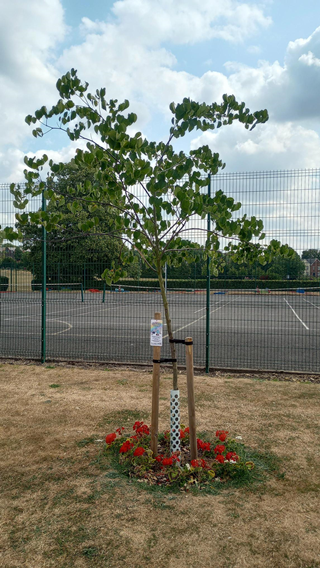
Trees provide vital habitats for wildlife, enhance our parks and neighbourhoods, improve air quality and help create greener, more attractive places. However, planting a tree is only the beginning. Newly planted trees need regular care and watering during their first few years to help their roots become established.
Young trees have recently been planted across a number of Council-owned parks, recreation grounds, housing sites and public open spaces, including:
- Newhall Park
- Maurice Lea Memorial Park
- Eureka Park
- Cadley Countryside Park
- Chestnut Avenue Recreation Ground
- Oversetts Road Recreation Ground
- Rosliston Forestry Centre
- Belfield Road
- Meadow Way
Residents are welcome to help water newly planted trees on Council-owned public open spaces. Even a small contribution can help, particularly during prolonged dry periods.
Why do young trees need additional water?
Established trees usually have extensive root systems that allow them to find water deeper in the ground. Newly planted trees have much smaller root systems and are therefore more vulnerable when the soil becomes dry.
Without enough water, young trees may struggle to establish, experience poor growth, become more vulnerable to pests and disease or, in severe cases, fail to survive.
The Arboricultural Association recommends that newly planted trees receive at least 50 litres of water each week during May, June, July and August for the first three years after planting. The exact amount needed can vary depending on the tree species, its location, the soil and recent weather conditions.
Fifty litres is approximately five standard 10-litre watering cans. Residents do not need to provide the full amount themselves, however. Regular contributions from people living near or visiting a tree can collectively make a significant difference.
How can I identify a newly planted tree?
Young trees are usually smaller and may have:
- Wooden stakes or supports beside the trunk
- Ties securing the tree to the stakes
- A watering pipe leading into the soil
- A watering bag fitted around the base
- A newly mulched or cleared area around the trunk
- A tree-watering tag asking people to help
Please only water trees that can be accessed safely on Council-owned public open spaces. Do not enter private gardens, fenced-off areas, construction sites or other restricted land.
When should I water a young tree?
Watering is particularly important during prolonged periods of dry or warm weather.
The best times to water are:
- Early in the morning, before temperatures rise
- Later in the evening, when the day has cooled
Watering at these times reduces the amount of water lost through evaporation and gives it more opportunity to soak into the soil around the roots.
How should I water a tree?
Water should be applied slowly so that it soaks into the ground rather than flowing away across the surface.
- Pour the water slowly onto the soil around the base of the tree.
- Spread the water over the surrounding soil rather than pouring everything directly against the trunk.
- Pause if water begins to run away and allow it to soak in before adding more.
- Avoid disturbing any mulch, stakes, ties or protective equipment.
A slow and thorough watering is more useful than quickly tipping water onto dry, compacted ground, where it may simply run away.
What type of water should I use?
Clean, cool water is the simplest and safest option.
Suitable sources include:
- Tap water
- Collected rainwater
- Leftover plain drinking water
Harvested rainwater is ideal where it is available. The Arboricultural Association also advises that bath water or water previously used for washing up may be suitable. However, household water should not contain bleach, disinfectant, dishwasher salt or harsh cleaning products. It should be used promptly rather than stored.
Every contribution helps
You do not need specialist equipment or large quantities of water to take part.
There are several simple ways to help:
- Take a watering can to a young tree near your home.
- Carry a bottle of plain water on your regular walk.
- Empty any leftover plain drinking water onto a young tree before leaving the park.
- Encourage children to help water a tree with an adult.
- Ask your sports team, walking group or community club to support a nearby tree.
- Adopt a tree near your home and water it regularly during dry periods.
- Share the campaign with neighbours and local groups.
A small amount of leftover water will not replace a tree’s full weekly watering requirement, but it can still contribute. The greatest benefit comes from people or groups providing a thorough watering regularly.
Could your community group get involved?
Schools, Scout and Guide groups, sports teams, walking groups, environmental organisations, resident associations and other community groups can all play a part.
Groups could:
- Adopt one or more young trees.
- Include tree watering in a regular walk or activity.
- Organise a supervised community watering session.
- Help raise awareness in their neighbourhood.
- Share photographs of their activity with the Council.
- Encourage members to look after trees near their homes.
Many young trees across South Derbyshire have already been planted through school and community projects. Supporting their aftercare is a positive way to continue that involvement and help ensure the trees remain part of the local landscape for years to come.
Groups interested in supporting trees regularly should contact the Council’s Trees and Woodlands team so they can be directed to suitable priority locations.
Look out for watering tags
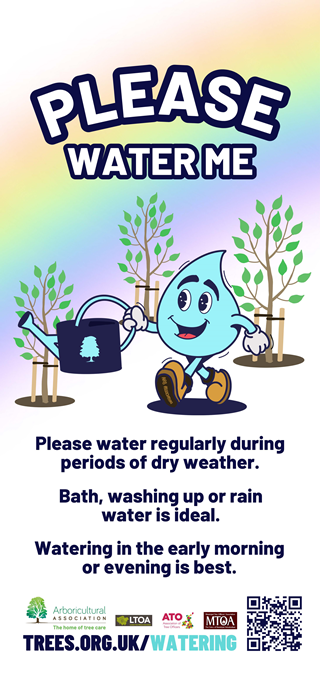
Watering tags are being used to help residents identify young trees that would particularly benefit from additional water.
The tags form part of the Arboricultural Association’s national Watering Young Trees campaign and provide a clear reminder that young trees need continued care after planting.
Not every recently planted tree will necessarily have a tag. Trees with stakes, watering pipes or watering bags may also be young trees that require support.
Please stay safe
When helping to water a tree:
- Remain on public land and use established paths where possible.
- Be careful near roads, car parks and cycle routes.
- Children should be supervised by an adult.
- Do not lift containers that are too heavy for you.
- Do not climb trees or interfere with stakes, ties, guards or watering equipment.
- Do not leave bottles, containers or other litter behind.
- Do not use water from ponds, rivers or other locations where collecting it may be unsafe or unauthorised.
- Stop if the ground or location is unsafe to access.
Council teams will continue to manage and care for trees across the district. Community watering provides valuable additional support during dry weather and does not replace the Council’s existing tree-maintenance work.
Please do not pour the following onto trees:
- Hot drinks
- Fizzy drinks
- Energy drinks
- Alcohol
- Milk or milky drinks
- Sugary or flavoured drinks
- Water containing bleach or disinfectant
- Salty water
- Water containing strong cleaning products
- Any unknown liquid or chemical
These liquids may contain sugar, acids, salt, fats, chemicals or other substances that could damage the tree or soil, leave unpleasant residues or attract pests.
Allow any reused water to cool before applying it. Never pour boiling or very hot water onto a tree.
Help give a young tree the best possible start
The trees planted today have the potential to benefit South Derbyshire’s communities, landscapes and wildlife for generations. By giving a young tree some water during dry weather, residents can help it become established and grow into a healthy mature tree.
Look out for a young tree near your home, in your local park or along your regular walking route - and help us give South Derbyshire’s trees the best possible start.
For further information or to ask about suitable trees in your area, contact:
Trees and Woodlands
TreesandWoodlands@southderbyshire.gov.uk
22 July 2026